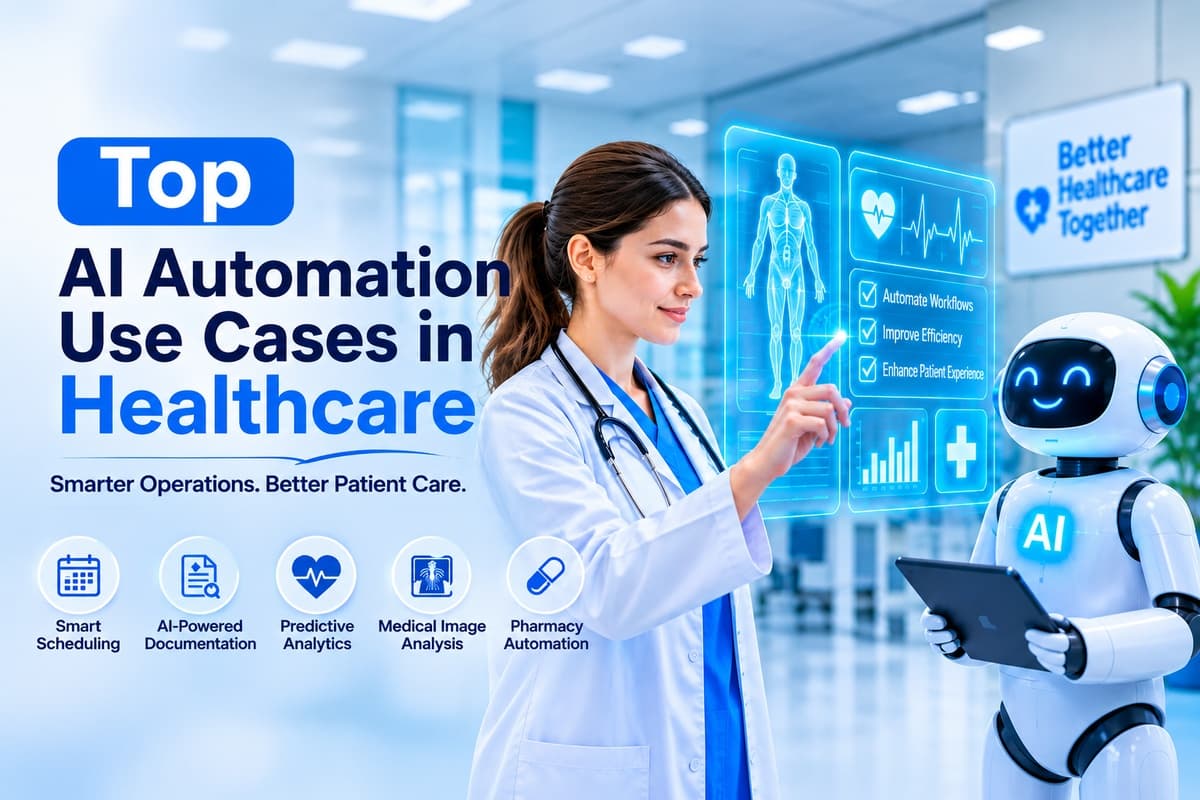
Top AI Automation Use Cases in Healthcare
AI is transforming healthcare by helping hospitals and clinics automate administrative tasks, improve workflows, and enhance patient experiences. From appointment scheduling and medical documentation to patient monitoring and data management, AI automation in healthcare helps reduce manual work and improve operational efficiency. In this article, we explore the top AI automation use cases, their benefits, and how healthcare organizations can use AI to improve their services.
1. Automated Patient Appointment Scheduling
Patient appointment scheduling is one of the most common administrative activities in healthcare. Hospitals and clinics receive numerous appointment requests, cancellations, and rescheduling inquiries every day.
AI-powered scheduling systems can automate these processes by checking appointment availability, managing booking requests, and sending reminders to patients.
How AI automation helps:
Automates appointment bookings and cancellations.
Sends reminders through SMS, email, or messaging platforms.
Helps patients find available appointment slots.
Manages rescheduling requests.
Reduces repetitive administrative work.
For example, an AI assistant on a clinic's website can help patients request appointments without waiting for staff assistance.
2. AI-Powered Medical Documentation
Medical documentation requires healthcare professionals to maintain accurate patient records, consultation notes, and treatment information.
AI-powered documentation tools can assist with converting spoken conversations into structured notes, summarizing consultations, and organizing medical information.
How AI automation helps:
Generates draft clinical notes from consultations.
Converts speech into text.
Summarizes patient information.
Reduces manual data entry.
Supports electronic health record (EHR) documentation.
Healthcare professionals can review and approve AI-generated documentation before adding it to official patient records.
3. Intelligent Patient Support and AI Chatbots
Patients frequently contact healthcare providers with questions about available services, appointment availability, clinic hours, and general procedures.
AI-powered chatbots can automate routine communication and provide patients with quick access to approved information.
How AI automation helps:
Answers frequently asked questions.
Provides clinic and service information.
Assists with appointment requests.
Shares general preparation instructions.
Routes complex inquiries to healthcare staff.
These chatbots can operate around the clock, helping patients access basic information outside regular business hours.
4. Automated Medical Billing and Insurance Claims
Medical billing and insurance claims involve multiple steps, including data entry, document verification, and claim preparation.
AI automation can help healthcare organizations process these activities more efficiently by extracting information, identifying missing details, and organizing billing documents.
How AI automation helps:
Extracts information from billing documents.
Identifies incomplete claim information.
Supports insurance verification workflows.
Organizes billing records.
Flags potential inconsistencies for review.
This reduces repetitive administrative work and helps billing teams manage documentation more efficiently.
5. AI-Powered Medical Image Analysis
Medical imaging is essential for identifying and evaluating various health conditions. AI-powered image analysis tools can assist radiologists in reviewing X-rays, CT scans, and MRI images.
These systems analyze medical images to identify patterns and highlight areas that may require further clinical examination.
How AI automation helps:
Supports medical image analysis.
Highlights potential abnormalities.
Helps prioritize imaging cases.
Assists radiologists with image review.
Supports clinical workflows.
AI-generated findings should always be reviewed by qualified healthcare professionals before clinical decisions are made.
6. Predictive Analytics for Patient Care
Predictive analytics uses machine learning and historical healthcare data to identify patterns and potential health risks.
Healthcare organizations can use these insights to support patient monitoring, prioritize follow-ups, and improve care planning.
How AI automation helps:
Identifies patients who may be at higher risk of readmission.
Analyzes historical patient information.
Supports chronic disease management.
Helps prioritize patient follow-ups.
Provides insights for healthcare planning.
For example, a hospital may use predictive analytics to identify patients who could benefit from additional monitoring after discharge.
7. Automated Patient Monitoring and Follow-Ups
Patient care often continues after a hospital visit or medical consultation. Follow-up reminders, medication notifications, and ongoing health monitoring are important parts of patient management.
AI-powered systems can help automate these activities and improve communication between healthcare providers and patients.
How AI automation helps:
Sends medication reminders.
Automates post-treatment follow-ups.
Analyzes information from connected health devices.
Identifies measurements that may require attention.
Sends alerts to healthcare teams.
This approach can support remote patient monitoring and help healthcare providers maintain communication between appointments.
8. Healthcare Workflow and Administrative Automation
Hospitals and clinics manage several administrative processes, including patient registration, document handling, data entry, and internal communication.
AI automation can streamline these workflows by reducing repetitive manual activities.
How AI automation helps:
Automates patient registration.
Processes digital intake forms.
Organizes electronic health records.
Routes documents to relevant departments.
Automates internal notifications.
By simplifying routine administrative processes, healthcare organizations can improve coordination and operational efficiency.
9. AI Automation in Pharmacy Management
Pharmacies manage medication inventories, prescriptions, and patient information. AI-powered automation can support inventory management and streamline routine administrative activities.
How AI automation helps:
Tracks medication inventory.
Identifies low-stock products.
Predicts potential inventory requirements.
Organizes prescription information.
Sends inventory notifications.
For example, an AI-powered inventory system can analyze historical medication usage and current stock levels to help pharmacies plan replenishment.
10. AI-Powered Healthcare Data Management
Healthcare organizations generate large volumes of information through patient records, laboratory reports, prescriptions, and insurance documents.
Managing this information manually can be time-consuming. AI-powered data management solutions use OCR, natural language processing, and intelligent document processing to extract and organize information.
How AI automation helps:
Extracts information from scanned medical documents.
Classifies healthcare records.
Automates repetitive data entry.
Organizes digital documents.
Makes information easier to retrieve.
Supports AI-powered knowledge search.
For example, an OCR-powered system can extract patient information from scanned forms and convert it into structured digital data.
11. Virtual Health Assistants
Virtual health assistants use AI to help patients access healthcare information and navigate routine healthcare services.
Unlike basic chatbots, advanced virtual assistants can understand more complex requests, retrieve information from approved knowledge sources, and coordinate tasks through connected systems.
How AI automation helps:
Answers routine patient questions.
Provides healthcare service information.
Helps patients navigate appointments.
Sends follow-up notifications.
Supports patient onboarding.
Connects patients with healthcare professionals when necessary.
These solutions can improve patient communication while allowing healthcare staff to focus on more complex responsibilities.
Benefits of AI Automation in Healthcare
AI automation offers several advantages for healthcare organizations:
Reduced Administrative Workload: Automates repetitive tasks such as scheduling, documentation, and data entry.
Improved Operational Efficiency: Streamlines workflows and reduces unnecessary manual processes.
Better Patient Experience: Makes routine communication and healthcare information more accessible.
Improved Data Management: Helps organize and retrieve information from large volumes of healthcare documents.
Support for Decision-Making: Provides useful insights through predictive analytics and AI-assisted analysis.
Consistent Workflows: Helps healthcare organizations standardize repetitive administrative activities.
Challenges of AI Automation in Healthcare
Despite its benefits, implementing AI automation requires careful planning.
Some common challenges include:
Protecting sensitive patient information.
Integrating AI solutions with existing healthcare systems.
Managing implementation and maintenance costs.
Ensuring the accuracy of AI-generated information.
Training healthcare staff to use new technologies.
Meeting applicable healthcare privacy and regulatory requirements.
Healthcare organizations should implement appropriate security measures, human oversight, and continuous monitoring to ensure responsible AI adoption.
How iBoon Helps Businesses Explore AI Automation
Implementing AI automation requires the right technology and development strategy. Healthcare organizations need solutions that address their operational challenges while maintaining data security and appropriate human oversight.
iBoon helps businesses explore AI-powered solutions and custom software development to improve their digital operations.
Its technology capabilities include:
AI Chatbots and Virtual Assistants: Automate routine inquiries and improve patient communication.
AI Agent Development: Build intelligent agents that can perform multi-step tasks and coordinate workflows.
OCR and Document AI: Extract, process, and organize information from scanned and digital documents.
RAG-Based AI Assistants: Develop intelligent assistants that retrieve relevant information from approved knowledge sources.
AI and Machine Learning Solutions: Build custom AI applications based on specific business requirements.
System Integration: Connect AI-powered solutions with existing business applications and workflows.
With the right AI automation strategy, healthcare organizations can simplify administrative operations, improve information management, and create more efficient digital experiences.
Explore iBoon's AI & ML Solutions to learn more.
Conclusion
AI automation is helping healthcare organizations streamline operations, reduce administrative workloads, and improve patient experiences. From appointment scheduling to medical documentation, AI-powered solutions make healthcare workflows more efficient.
With the right technology, data security, and human oversight, healthcare providers can focus more on delivering quality patient care.
Looking to automate your business with AI? Connect with iBoon to explore custom AI solutions tailored to your needs.